




EDF has introduced, as part of its “Je passe à l’électrique” programme, a Cooling Bonus for schools, nurseries and leisure centres.
For the “summer 2026” scheme, open until 30 September 2026, ceiling fans are eligible. The grant can reach up to €400 per unit, within a limit of 10 units per establishment, corresponding to a maximum reimbursement of €4,000 per site. If the purchase price of a unit is below €400, it can be reimbursed at 100% of its purchase cost.
The scheme is part of a €40 million budget announced by EDF[i], aimed at supporting more than 10,000 establishments and helping to finance over 100,000 pieces of equipment.
Which institutions are eligible?
The scheme is open to public and private educational institutions under contract with the French Ministry of Education, from nursery school through to high school, as well as municipal leisure centres and municipal nurseries. Private institutions without a contract are not eligible.
The grant is not limited to EDF customers: it is available to all eligible institutions regardless of their energy supplier. It covers mainland France. In Corsica and overseas territories, EDF refers applicants to its Agir Plus programmes.
A multi-site operator may submit several applications, provided the limit of 10 units per establishment is respected, meaning per SIRET number and per site.
Why are ceiling fans particularly relevant?
In classrooms, nurseries, leisure centres and shared spaces, ceiling fans are a simple, low-energy solution that can be deployed immediately and are compatible with climate adaptation strategies.
Their main benefit is not to lower air temperature, but to improve perceived thermal comfort for occupants by keeping air in motion. EDF also presents ceiling fans as equipment capable of reducing perceived temperature by up to 4°C.
It should also be noted that even when air conditioning is present, ceiling fans remain beneficial: they help significantly reduce the “cold draft” effect of air conditioning by improving air distribution throughout the room. They also allow for an increase in the air conditioning setpoint (for example 29°C instead of 26°C), resulting in energy savings of around 30%.
For building owners and engineering consultants, the advantage is twofold: reducing electrical demand and avoiding, where possible, the use of more energy-intensive or installation-heavy systems.
Which expenses are covered?
The scheme covers the actual purchase costs of the equipment. For ceiling fans, the invoice must be dated between 26 June and 30 September 2026. The reimbursement request must also be submitted no later than 30 September 2026.
The equipment must be intended for areas open to the public within the institution. A sworn statement must be signed by the head of the institution or school principal, stamped with the institution’s official seal, and submitted together with the purchase invoices.
What is the procedure to follow?
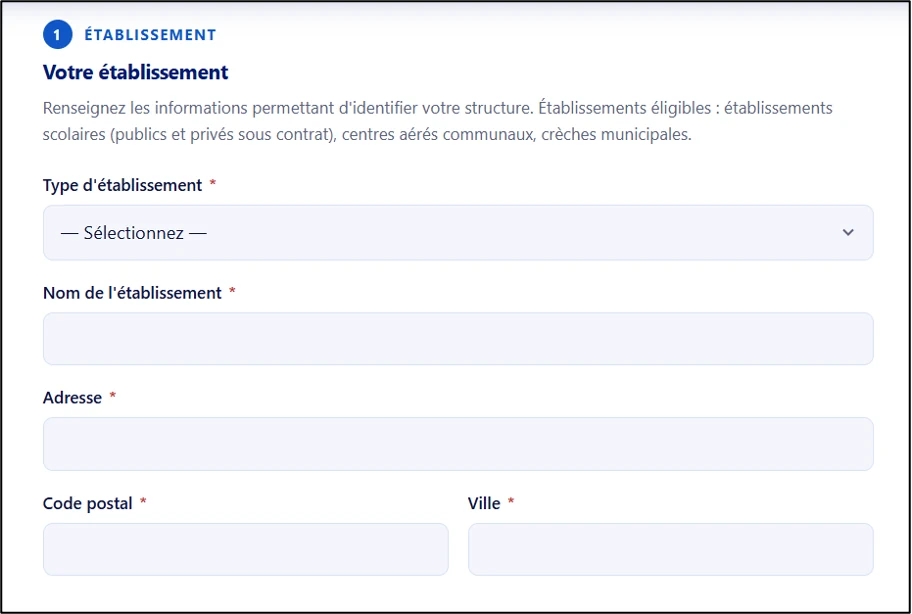
The procedure is deliberately straightforward. The institution first purchases the equipment from the supplier of its choice, then completes the online form, submits the invoices, and attaches the signed sworn statement. After the application is reviewed, the reimbursement is paid directly to the institution’s bank account.
Bank details are requested during the application review process, once the file has been validated. Applications are submitted online via the dedicated platform:
https://www.jepassealelectrique-frais.fr/solutions-temporaires
Key considerations for building owners
The scheme operates on a post-purchase reimbursement basis, upon submission of invoices. It is therefore not, at this stage, a pre-booking system based on quotations. This requirement should be taken into account in procurement decisions, as the dedicated budget for rapidly deployable equipment is capped at €40 million.
Given the high media visibility of this initiative, building owners are encouraged to begin projects as soon as a real need has been identified.
For ceiling fan projects, priority should remain on proper technical design: number of units, layout, ceiling height, potential obstacles, noise levels, installation safety, maintenance, and suitability for actual room usage.
The EDF bonus can help accelerate implementation, but it does not replace a technical assessment of the site. A poorly positioned, undersized or unsuitable ceiling fan will result in insufficient or uncomfortable airflow. Conversely, a well-designed layout can significantly improve summer comfort, with very low electricity consumption and generally simpler implementation than active cooling systems.